Available through:
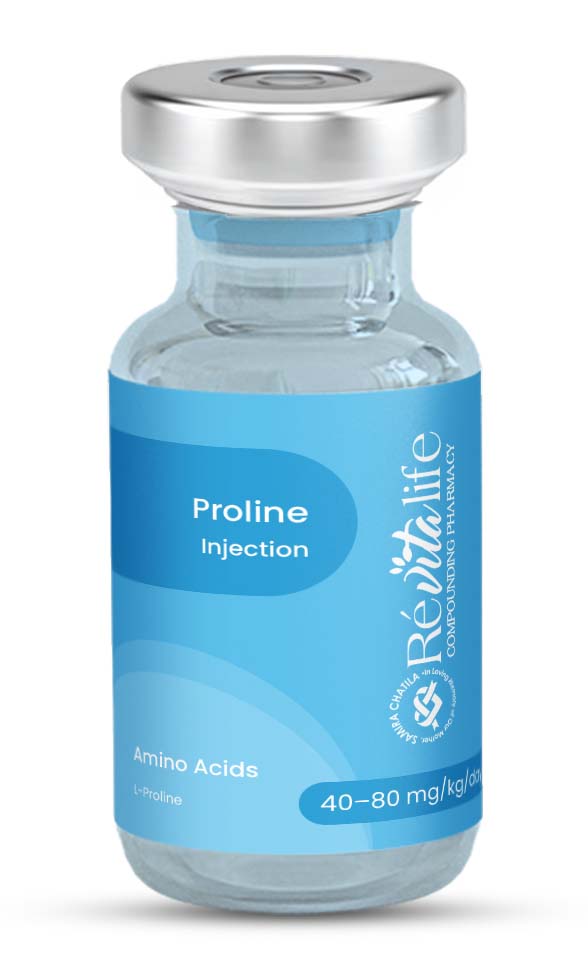
Proline Injection
Available Dosage Strengths
About Proline Injection
Generic Name: L-Proline
Drug Class: Non-essential, proteinogenic amino acid; substrate for collagen synthesis.
Route: Intravenous (IV), only as part of commercial or compounded amino-acid infusions.
Pharmaceutical Form:
- Mixed amino-acid PN solutions (5–20% AA)
- Not supplied as a single-component injection for standalone infusion.
Clinical Use:
- Component of parenteral nutrition to meet nitrogen and amino-acid requirements in patients unable to receive adequate enteral nutrition.
- Supports collagen formation, wound healing, and structural protein synthesis.
Key Metabolic Roles:
- Precursor and structural component of collagen (rich in proline/hydroxyproline).
- Participates in cellular redox balance through the proline-P5C cycle.
- Facilitates tissue repair, fibroblast activity, and extracellular matrix formation.
Dosage
Important:
Proline is not dosed individually; its quantity is determined by the proportions within total amino-acid formulas. Distributed among the full amino-acid profile, it contributes to total nitrogen intake.
A. Adult PN Requirements
- Total amino acids: 1–2 g/kg/day (standard).
- Proline represents ~ 4–8% of amino-acid solution content depending on the formulation.
- This corresponds approximately to 40–80 mg/kg/day of proline (dependent on product composition).
B. Pediatric Requirements
- Infants/children: 2–3 g/kg/day of total amino acids.
- Proline proportion: Similar to adult formulas → ~ 80–160 mg/kg/day.
C. Increased Requirements
- Severe burns
- Trauma
- Major surgery
- Critically ill catabolic states
(↑ Total amino acids to 1.5–2.5 g/kg/day → proportional rise in proline intake.)
D. Administration
- Infuse as part of a PN admixture through central venous access when osmolarity is high.
- DO NOT administer as IV push or single-amino-acid infusion.
Monitoring:
- Nitrogen balance
- Serum electrolytes
- Liver and renal function
- Blood glucose
- Triglycerides (if lipids included)
Mechanisms Of Action
A. Collagen Synthesis
- Proline constitutes ~25% of the amino-acid residues in collagen (in combination with hydroxyproline).
- Essential to stabilization of the collagen triple helix, supporting:
- Wound healing
- Skin integrity
- Tendon/ligament repair
- Vascular structural strength
B. Proline ↔ Pyrroline-5-carboxylate (P5C) Cycle
- Redox shuttle between proline and P5C contributes to cellular NADP+/NADPH balance.
- Supports antioxidant systems and mitochondrial metabolism.
C. Energy Production
- Can be converted to glutamate → α-ketoglutarate → TCA cycle entry.
- Provides substrate during stress states.
D. Osmoprotection and Cellular Integrity
- Stabilizes protein folding
- Protects intracellular structures under stress conditions (oxidative or osmotic)
E. Support for Fibroblasts
Proline is required for fibroblast proliferation and extracellular matrix (ECM) formation.
Contraindications & Precautions
Absolute Contraindications
- Inborn errors of proline metabolism
- Hyperprolinemia type I & II
- Severe metabolic disorders preventing proper amino-acid utilization
- Hypersensitivity to amino-acid solutions (exceptionally rare)
Relative Contraindications
- Severe hepatic impairment: Reduced amino-acid clearance → risk of imbalance
- Renal failure: Risk of elevated BUN → adjust total amino acids
- Sepsis or hemodynamic instability: PN may need staged introduction
- Fluid/electrolyte disturbances: Correct abnormalities before PN initiation
- Refeeding syndrome risk: Initiate PN slowly in malnourished patients
Precautions
- Monitor for amino-acid imbalance or hyperaminoacidemia.
- Proline accumulation is uncommon but possible in hepatic failure.
- Long-term PN requires monitoring for trace element or vitamin imbalances.
Interactions
Proline itself has minimal direct interactions, but PN admixtures involve complex compatibility considerations.
Drug Interactions
- None specific to proline
- However, metabolic interactions can occur due to:
- Corticosteroids: Increased protein catabolism → altered AA requirements
- Insulin therapy: Affects amino-acid uptake and protein synthesis
- Acid–base modifying agents: Can alter amino-acid metabolism indirectly
Nutritional/PN Interactions
- Vitamin C deficiency: Impairs proline → hydroxyproline conversion, compromising collagen.
- Copper deficiency: Reduces lysyl oxidase activity → weak collagen crosslinking.
- Excessive glycine/alanine intake may alter amino-acid ratios and nitrogen balance.
Compatibility Considerations (PN admixtures)
- Must follow institutional PN compounding guidelines.
- Stability may be affected by:
- Calcium/phosphate solubility
- Lipid emulsion stability
Overall osmolarity
Adverse Reactions / Side Effects
Most adverse reactions are related to total PN therapy, not proline specifically.
Common (PN-related)
- Nausea
- Vomiting
- Mild fever or infusion discomfort
- Elevated BUN (from total nitrogen load)
- Hyperglycemia (PN carbohydrate component)
- Electrolyte abnormalities
Proline-Specific Considerations
- Hyperprolinemia (rare without metabolic disorders)
Symptoms may include:- Neurologic changes
- Seizures (in genetic metabolic disorders)
- Cognitive alterations
- Amino-acid imbalance if hepatic metabolism impaired
Severe (rare)
- Anaphylactoid reactions to amino-acid solutions
- Liver dysfunction with long-term high-dose PN
- Metabolic acidosis from improper PN formulation
- Refeeding syndrome (phosphate, potassium, magnesium shifts)
Pregnancy & Breastfeeding
Pregnancy
- Proline is a normal nutritional requirement and is safe when delivered as part of PN.
- No teratogenic effects documented at nutritional doses.
- PN in pregnancy must be closely monitored for:
- Glucose levels
- Electrolytes
- Adequate micronutrient intake
- Excessive amino-acid load should be avoided to prevent azotemia.
Breastfeeding
- Safe when used in PN at standard doses.
- No evidence of significant alteration of breast milk composition when maternal amino-acid levels are normal.
- Mothers on PN require monitoring for hydration, electrolytes, and calorie sufficiency.
Storage
For commercial amino-acid solutions containing proline:
- Temperature: Store at 20–25°C (68–77°F).
- Do not freeze; discard if frozen.
- Protection from light: Recommended for multi-component PN solutions.
- Inspect for:
- Cloudiness
- Precipitates
- Leaks
- Use aseptic technique during compounding.
- Follow compounding policy for beyond-use dating (BUD):
- Typically 24 hours at room temperature once prepared
Up to 7–9 days refrigerated for many PN formulations (depending on stability testing)
References
(Professional, authoritative medical sources – no URLs)
- ASPEN (American Society for Parenteral and Enteral Nutrition). Guidelines for the Use of Parenteral Nutrition in Adults and Children.
- ESPEN (European Society for Clinical Nutrition and Metabolism). Guidelines on Parenteral Nutrition.
- S. Pharmacopeia (USP). Amino Acid Injection Monographs.
- Morrison & Boyd. Clinical Nutrition: Parenteral Nutrition Handbook.
- Nelson, Cox. Lehninger Principles of Biochemistry – Collagen and Amino-Acid Metabolism.
- Medical Nutrition Therapy Textbook – PN Chapters.
- Biochemistry of Collagen – Proline and Hydroxyproline Metabolism (Peer-reviewed sources).