
Available through:
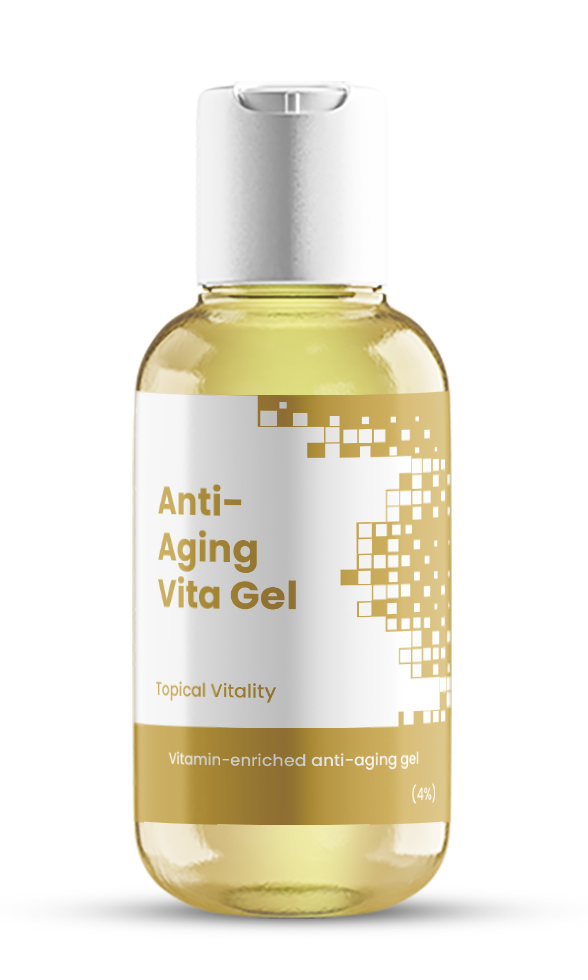
Anti-Aging Vita Gel
Available Dosage Strengths
About Anti-Aging Vita Gel
Anti-Aging Vita Gel is a pharmacist-compounded, prescription-only hydrogel that combines 4 % niacinamide, 0.03 % tretinoin, and 5 % l-ascorbic acid in a 30 g air-tight tube, produced under the quality standards of a 503A pharmacy to serve individual patient needs. The formulation was designed to address photoaging, uneven pigmentation, and texture changes by delivering complementary B-vitamin, retinoid, and antioxidant pathways that may improve epidermal turnover while reinforcing the stratum corneum barrier. [1]
Long-term clinical investigations suggest that niacinamide at concentrations of 4 % or greater can decrease transepidermal water loss, reduce blotchy erythema, and soften fine wrinkles, whereas tretinoin remains the benchmark topical retinoid for dermatoheliosis, stimulating collagen synthesis and inhibiting matrix metalloproteinases; the addition of l-ascorbic acid provides reactive-oxygen-species scavenging and co-factor support for pro-collagen hydroxylation, potentially yielding superior global photoaging scores relative to monotherapy. [2]
Dosage
Apply a pea-sized amount once nightly to clean, fully dry skin, avoiding mucosal surfaces and periocular areas; introductory regimens often utilize every-other-night application for two weeks before advancing to nightly use as tolerated. Continuous therapy beyond 12 weeks has demonstrated incremental benefits, with clinical protocols allowing maintenance for 6-12 months provided dermatologic follow-up confirms tolerability. [9]
Mechanisms of Action
Tretinoin (all-trans-retinoic acid) binds nuclear RAR-α/β/γ receptors, initiating transcriptional cascades that accelerate keratinocyte differentiation, normalize keratinization, and down-regulate AP-1-mediated collagenase, thereby decreasing dermal matrix degradation and improving epidermal thickness. [3]
Ascorbic acid functions as a co-substrate for prolyl and lysyl hydroxylase, stabilizing the collagen triple helix while quenching UV-induced free radicals; topical delivery at acidic pH enhances percutaneous absorption, and the presence of niacinamide may further augment dermal vitamin C bioavailability through improved barrier integrity and reduced oxidative load. [4]
Contraindications & Precautions
Use is contraindicated in patients with known hypersensitivity to niacinamide, retinoids, or ascorbic-acid derivatives and in those with eczematous or inflamed skin where barrier compromise could intensify retinoid dermatitis; individuals on photosensitizing therapies, such as systemic fluoroquinolones or thiazides, may experience heightened irritation and should avoid concomitant initiation without dermatologic supervision. [5]
Interactions
Typical adverse events include transient stinging, desquamation, and erythema during the first 2-4 weeks; incorporation of niacinamide has been shown to reduce transepidermal water loss and subjective irritation scores versus retinoid monotherapy, though patients with Fitzpatrick I-II skin may still report more pronounced erythema during winter months. [7]
Adverse Reactions / Side Effects
Typical adverse events include transient stinging, desquamation, and erythema during the first 2-4 weeks; incorporation of niacinamide has been shown to reduce transepidermal water loss and subjective irritation scores versus retinoid monotherapy, though patients with Fitzpatrick I-II skin may still report more pronounced erythema during winter months. [7]
Pregnancy & Breastfeeding
Topical tretinoin is classified as Pregnancy Category C, and systemic absorption from dermatologic use is low but not negligible; thus, therapy should generally be discontinued when planning pregnancy or during gestation. [8]
Niacinamide and vitamin C possess favorable maternal-fetal safety profiles at typical topical concentrations, yet data remain insufficient for definitive risk categorization of this compounded triple-agent gel. [8]
Storage
Retinoids and ascorbic-acid-containing preparations degrade under heat, light, and oxygen; store at 20-25 °C (68-77 °F) in the original opaque container, cap tightly after each use. [10]
References
01. Ong, R. R., & Goh, C. F. (2024). Niacinamide: A review on dermal delivery strategies and clinical evidence. Drug Delivery and Translational Research, 14, 3512-3548. [https://doi.org/10.1007/s13346-024-01593-y\\
\- Link Opens in New Tab](https://doi.org/10.1007/s13346-024-01593-y)
02. Comparing tretinoin to other topical therapies in the reduction of skin aging. (2024). Dermatologic Therapy, 34(9), e00893. [https://doi.org/10.1007/s40257-024-00893-w\\
\- Link Opens in New Tab](https://doi.org/10.1007/s40257-024-00893-w)
03. OasisDerm. (2025). Tretinoin: Pharmacology and mechanism of action PDF. [https://oasisderm.com/wp-content/uploads/2025/01/Tretinoin.pdf\\
\- Link Opens in New Tab](https://oasisderm.com/wp-content/uploads/2025/01/Tretinoin.pdf)
04. Ando, H. (2022). Ascorbic acid as a cosmeceutical to increase dermal collagen. Antioxidants, 11(9), 1663. [https://doi.org/10.3390/antiox11091663\\
\- Link Opens in New Tab](https://doi.org/10.3390/antiox11091663)
05. Cutaneous reactions to retinoids. (2019). In Retinoids in Dermatology (pp. 615-630). Springer. [https://doi.org/10.1007/978-1-4471-6729-7\_34\\
\- Link Opens in New Tab](https://doi.org/10.1007/978-1-4471-6729-7_34)
06. SkinCareStacy. (2023). Using niacinamide and tretinoin together. [https://skincarestacy.com/tretinoin-and-niacinamide/\\
\- Link Opens in New Tab](https://skincarestacy.com/tretinoin-and-niacinamide/)
07. Sunday Edit. (2023). 6 niacinamide myths, debunked. [https://edit.sundayriley.com/niacinamide-myths-debunked/\\
\- Link Opens in New Tab](https://edit.sundayriley.com/niacinamide-myths-debunked/)
08. Drugs..com. (2023). Tretinoin topical: Use during pregnancy. [https://www.drugs.com/pregnancy/tretinoin-topical.html\\
\- Link Opens in New Tab](https://www.drugs.com/pregnancy/tretinoin-topical.html)
09. Drugs..com. (2023). Tretinoin topical dosage guide. [https://www.drugs.com/dosage/tretinoin-topical.html\\
\- Link Opens in New Tab](https://www.drugs.com/dosage/tretinoin-topical.html)
10. Stability of vitamin C derivatives in topical formulations. (2018). International Journal of Cosmetic Science, 40(6), 511-520. [https://store.agelyss.com/downloads/Stability\_of\_vitamin\_C\_derivatives\_in\_to.pdf\\
\- Link Opens in New Tab](https://store.agelyss.com/downloads/Stability_of_vitamin_C_derivatives_in_to.pdf)
11. Food and Drug Administration. (2016). Pharmacy compounding of human drug products under section 503A (Guidance for Industry). [https://www.fda.gov/media/94393/download\\
\- Link Opens in New Tab](https://www.fda.gov/media/94393/download)
12. Food and Drug Administration. (2017). Prescription requirement under section 503A of the FD&C Act (Guidance for Industry). [https://www.fda.gov/files/drugs/published/Prescription-Requirement-Under-Section-503A.pdf\\
\- Link Opens in New Tab](https://www.fda.gov/files/drugs/published/Prescription-Requirement-Under-Section-503A.pdf)
13. Andrade, P. N., et al. (2023). Efficacy of topical vitamin C in melasma and photoaging: A systematic review. Journal of Cosmetic Dermatology, 22(1), 45-56. [https://doi.org/10.1111/jocd.15748\\
\- Link Opens in New Tab](https://doi.org/10.1111/jocd.15748)
14. Romper. (2024). Everything you need to know about using niacinamide during pregnancy. [https://www.romper.com/pregnancy/niacinamide-pregnancy\\
\- Link Opens in New Tab](https://www.romper.com/pregnancy/niacinamide-pregnancy)
15. California Skin Institute. (2024). CSI dermatologists’ guide to pregnancy skincare ingredient safety. [https://www.californiaskininstitute.com/csi-dermatologists-free-guide-to-pregnancy-skincare-ingredient-safety/\\
\- Link Opens in New Tab](https://www.californiaskininstitute.com/csi-dermatologists-free-guide-to-pregnancy-skincare-ingredient-safety/)
16. American Osteopathic College of Dermatology. (2024). Topical retinoids. [https://www.aocd.org/page/Retinoidstopical\\
\- Link Opens in New Tab](https://www.aocd.org/page/Retinoidstopical)
17. Cosmetic Ingredient Review Expert Panel. (2018). Safety assessment of ethers and esters of ascorbic acid as used in cosmetics. [https://www.cir-safety.org/sites/default/files/ethasb062017rep.pdf\\
\- Link Opens in New Tab](https://www.cir-safety.org/sites/default/files/ethasb062017rep.pdf)
18. Odyssey Street. (2024). Retinol creams: Storage tips. [https://odysseystreet.com/blogs/beauty/retinol-creams-storage-tips\\
\- Link Opens in New Tab](https://odysseystreet.com/blogs/beauty/retinol-creams-storage-tips)
19. American College of Osteopathic Family Physicians. (2024). Vitamin C, topical retinoids, and sunscreen in clinical practice. [https://www.acofp.org/news-and-publications/journal/article-detail/vol-16-no-3-fall-2024/vitamin-c-topical-retinoids-sunscreen-in-clinical-practice-essentials-for-family-physicians\\
\- Link Opens in New Tab](https://www.acofp.org/news-and-publications/journal/article-detail/vol-16-no-3-fall-2024/vitamin-c-topical-retinoids-sunscreen-in-clinical-practice-essentials-for-family-physicians)
20. LittleBabyGear. (2023). Is niacinamide safe during pregnancy? [https://www.littlebabygear.com/is-niacinamide-safe-during-pregnancy/\\
\- Link Opens in New Tab](https://www.littlebabygear.com/is-niacinamide-safe-during-pregnancy/)
21. Castanedo-Cazares, J. P., et al. (2013). Topical niacinamide 4 % for axillary hyperpigmentation: Randomized controlled study. Clinical, Cosmetic and Investigational Dermatology, 6, 29-36. [https://doi.org/10.2147/CCID.S39246\\
\- Link Opens in New Tab](https://doi.org/10.2147/CCID.S39246)
22. Giardina, V. (2025, July 1). Shop TruSkin for 40 % off with Post Wanted’s exclusive code. New York Post. [https://nypost.com/2025/07/01/shopping/shop-truskin-for-40-off-with-post-wanteds-exclusive-code/\\
\- Link Opens in New Tab](https://nypost.com/2025/07/01/shopping/shop-truskin-for-40-off-with-post-wanteds-exclusive-code/)
Disclaimer
This compounded medication is prepared under section 503A of the U.S. Federal Food, Drug, and Cosmetic Act. Safety and efficacy for this formulation have not been evaluated by the FDA. Therapy should be initiated and monitored only by qualified healthcare professionals.
About Us
We believe in a comprehensive approach to healthcare that blends traditional wisdom with cutting-edge techniques to deliver personalized care that addresses not just the symptoms, but also the underlying causes of your health concerns.
Frequently asked questions
Our team of experts has the answers you’re looking for.
Why is Anti-Aging Vita Gel only available from a compounding pharmacy?
Section 503A of the FD&C Act permits pharmacies to create patient-specific medications that are not commercially manufactured, enabling customization of active-ingredient ratios and excipients to clinician specifications. [11]
Do I still need a valid prescription?
Yes. Under 503A, a licensed prescriber’s patient-specific order is mandatory before compounding and dispensing. [12]
How long before benefits appear?
Controlled trials of topical vitamin C report statistically significant improvements in pigmentation and fine lines after 12 weeks, and synergistic regimens with retinoids often show earlier textural gains by week 8. [13]
Is niacinamide safe during pregnancy if I stop the gel?
Dermatologists generally consider topical niacinamide safe at concentrations ≤ 5 %, but this compounded product still contains tretinoin and should be avoided while pregnant. [14]
What about vitamin C in pregnancy?
Vitamin C is widely accepted as pregnancy-compatible when topically applied, offering antioxidant support without teratogenic risk. [15]
How does tretinoin work?
Topical retinoids bind RAR receptors, accelerating epidermal turnover, smoothing keratinocyte architecture, and up-regulating collagen production, collectively improving dyschromia and rhytides. [16]
Could ascorbic acid cause irritation?
High-potency l-ascorbic acid (> 15 %) is acidic and may sting, but safety reviews of ascorbic-acid esters at 5 % report low incidence of contact dermatitis. [17]
How should I store the gel?
Keep the tube at room temperature, away from direct light, and never in a humid bathroom to maintain retinoid stability. [18]
Do I need sunscreen?
Daily broad-spectrum mineral sunscreen is essential because retinoids increase UV sensitivity and antioxidants function best in UV-safe conditions. [19]
Can I layer other actives?
Introduce exfoliating acids cautiously and never on the same night; niacinamide is generally compatible and may lessen irritation. [20]
Does niacinamide strengthen the skin barrier?
Studies show 4 % niacinamide up-regulates ceramide synthesis and reduces transepidermal water loss, supporting barrier recovery. [21]
Is this product commercially available?
At present, Anti-Aging Vita Gel is compounded per prescription and not sold over the counter; however, interest in similar combination serums reflects the growing market for multi-active skincare. [22]