
Available through:
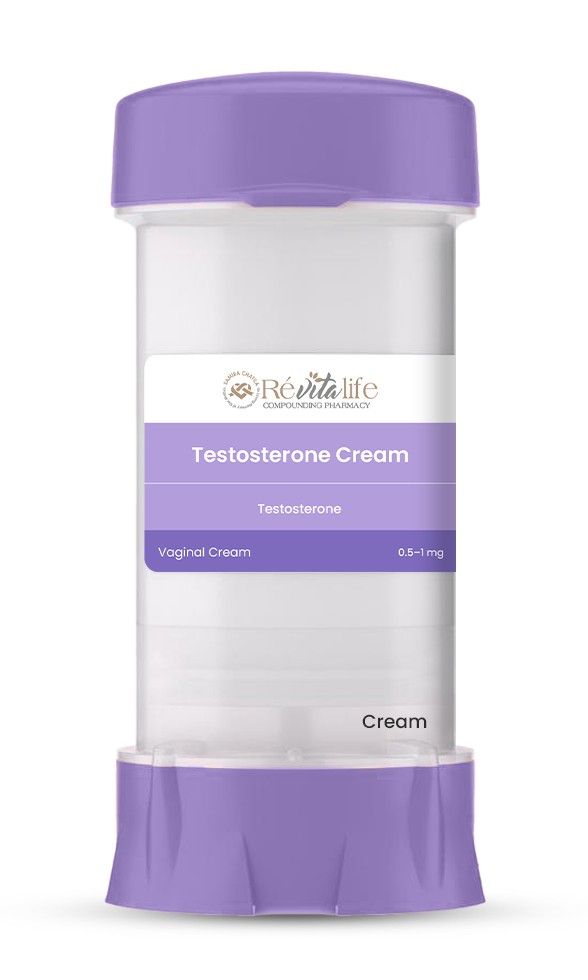
Testosterone Vaginal Cream
Available Dosage Strengths
About Testosterone Vaginal Cream
Testosterone Vaginal Cream is a compounded, bioidentical preparation formulated to deliver testosterone directly to vulvovaginal tissues, where declining androgen levels have been implicated in post-menopausal atrophy, dryness, pruritus, dyspareunia, and diminished libido¹. Local application concentrates the hormone at epithelial, muscular, and neurovascular sites that express androgen receptors, supporting epithelial maturation, collagen synthesis, and genital sensation while minimizing systemic exposure; clinicians therefore consider it when standard estrogen therapy is ineffective, contraindicated, or poorly tolerated¹. Off-label compounded products increasingly meet this need because no testosterone medication is currently approved for use in cisgender women in the United States, rendering prescription through a 503A pharmacy the only practical route for dose-tailored therapy. [¹]
Public interest in female androgen therapy has surged alongside social-media testimonials and emerging observational data describing improvements in sexual desire, mood, cognition, energy, and musculoskeletal health². Nevertheless, experts emphasize cautious patient selection, individualized dosing, and periodic biochemical monitoring to avoid supra-physiologic levels and to detect early signs of androgen excess. The cream’s 20 mg/mL concentration in a 30 mL dispenser allows titration with calibrated applicators, typically 0.25-0.5 mL per use, but prescribers may adjust frequency based on symptom relief, serum levels, and safety profile. Because compounded formulations lack FDA review, clinicians must apprise patients of variability risks and counsel on proper storage, hygiene, and follow-up, underscoring that benefits remain probabilistic and safety data are still evolving.
Dosage
Clinical guidelines suggest initiating therapy at the lowest effective amount, commonly 0.25 mL (5 mg testosterone) intravaginally once daily. [⁹] Serum total and free testosterone should be measured at baseline and after six to eight weeks, timing the sample midway between doses. Target values generally correspond to the upper quartile of pre-menopausal reference ranges; exceeding that threshold or experiencing androgenic side effects warrants dose reduction. Lack of clinical response after a three- to six-month trial despite optimized levels should prompt reevaluation of diagnosis and discontinuation.
Mechanisms of Action
Testosterone acts as an agonist at the androgen receptor, a ligand-activated transcription factor distributed throughout vaginal epithelium, stromal fibroblasts, pelvic floor musculature, peripheral nerves, and vascular endothelium³. Upon binding, the hormone-receptor complex translocates to the nucleus, where it modulates expression of genes governing keratinocyte proliferation, collagen cross-linking, nitric-oxide synthase activity, and neurosensory remodeling, thereby enhancing tissue integrity, lubrication, and sensitivity.
Vaginal delivery exploits favorable pharmacokinetics: a single intravaginal dose produces a rapid but transient rise in serum testosterone that peaks within six hours before returning toward baseline by 24 hours, indicating limited systemic accumulation⁴. Concurrent measurements of estradiol remain unchanged, suggesting minimal aromatization locally; thus therapeutic effects largely stem from androgen receptor engagement. Repeated dosing sustains local androgenic milieu without exceeding physiologic systemic ranges in most patients, though inter-individual variability necessitates periodic plasma monitoring and symptom-guided titration.
Contraindications & Precautions
Absolute contraindications include known or suspected androgen-dependent neoplasms, active or recent breast carcinoma, and undiagnosed genital bleeding, where exogenous testosterone could exacerbate tumor growth or mask diagnostic clues.
Interactions
Comprehensive interaction databases list more than 170 medications with potential to alter testosterone metabolism or amplify its physiologic effects.
Adverse Reactions / Side Effects
Cutaneous androgenic sequelae-acneiform eruptions, seborrhea, and unwanted terminal hair growth-represent the most common adverse events, typically dose-related and reversible with titration or discontinuation.
Pregnancy
Testosterone is teratogenic; exposure during pregnancy may masculinize a female fetus or disrupt endocrine development, and thus therapy is contraindicated in individuals who are pregnant or planning conception.
Storage
The cream should be kept tightly closed at controlled room temperature, 20 °C-25 °C (68 °F-77 °F), protected from heat, moisture, and direct light to preserve potency.
References
- Whitton, K., & Baber, R. (2024). Androgen-based therapies in women. Best Practice & Research Clinical Endocrinology & Metabolism, 38(1), 101783. [https://doi.org/10.1016/j.beem.2023.101783\\
\- Link Opens in New Tab](https://doi.org/10.1016/j.beem.2023.101783)
- Haupt, A. (2025, February 19). Testosterone therapy is trending-for women. Time. [https://time.com/7259392/testosterone-therapy-women-benefits-risks/\\
\- Link Opens in New Tab](https://time.com/7259392/testosterone-therapy-women-benefits-risks/)
- DrugBank Online. (2025). Testosterone: Uses, interactions, mechanism of action. [https://go.drugbank.com/drugs/DB00624\\
\- Link Opens in New Tab](https://go.drugbank.com/drugs/DB00624)
- Apperloo, M., Midden, M., van der Stege, J., Wouda, J., Hoek, A., & Weijmar Schultz, W. (2006). Vaginal application of testosterone: Pharmacokinetics and sexual response in healthy volunteers. Journal of Sexual Medicine, 3(3), 541-549. [https://doi.org/10.1111/j.1743-6109.2006.00146.x\\
\- Link Opens in New Tab](https://doi.org/10.1111/j.1743-6109.2006.00146.x)
- Bianchi, V., et al. (2023). Impact of testosterone therapy on cardiovascular risk among postmenopausal women: A scoping review. Journal of the Endocrine Society, 8(1), bvad132. [https://doi.org/10.1210/jendso/bvad132\\
\- Link Opens in New Tab](https://doi.org/10.1210/jendso/bvad132)
- Drugs.com. (2025). Testosterone topical interactions. [https://www.drugs.com/drug-interactions/testosterone-topical.html\\
\- Link Opens in New Tab](https://www.drugs.com/drug-interactions/testosterone-topical.html)
- IYTmed. (2024). Testosterone cream side effects for females. [https://iytmed.com/testosterone-cream-side-effects-for-females/\\
\- Link Opens in New Tab](https://iytmed.com/testosterone-cream-side-effects-for-females/)
- Centers for Disease Control and Prevention. (2024). Testosterone use and risk for pregnancy. [https://www.cdc.gov/contraception/hcp/usspr/testosterone-pregnancy-risk.html\\
\- Link Opens in New Tab](https://www.cdc.gov/contraception/hcp/usspr/testosterone-pregnancy-risk.html)
- Alabama Board of Medical Examiners. (2025). Recommended guidelines for testosterone replacement therapy in females. [https://www.albme.gov/uploads/pdfs/TRT\_GuidelinesFem.pdf\\
\- Link Opens in New Tab](https://www.albme.gov/uploads/pdfs/TRT_GuidelinesFem.pdf)
- MassGainsSource. (2023). The truth about testosterone and refrigeration. [https://www.massgainssource.com/testosterone-2/does-testosterone-need-to-be-refrigerated/\\
\- Link Opens in New Tab](https://www.massgainssource.com/testosterone-2/does-testosterone-need-to-be-refrigerated/)
- Black, A., & Shapiro, H. (2014). Androgen therapy in women. U.S. Pharmacist, 39(9). [https://www.uspharmacist.com/article/androgen-therapy-in-women\\
\- Link Opens in New Tab](https://www.uspharmacist.com/article/androgen-therapy-in-women)
- Glaser, R. et al. (2020). Compounded testosterone therapy in women Poster. [https://hormonebalance.org/wp-content/uploads/2020/06/Glaser-Poster-presentations-WEB/COMPOUNDED-TESTOSTERONE-THERAPY-IN-WOMEN.pdf\\
\- Link Opens in New Tab](https://hormonebalance.org/wp-content/uploads/2020/06/Glaser-Poster-presentations-WEB/COMPOUNDED-TESTOSTERONE-THERAPY-IN-WOMEN.pdf)
- Lemke, M. (2017). Vaginal testosterone for management of aromatase inhibitor-related sexual dysfunction. Oncology Nursing Forum, 44(3), 224-230. [https://www.ons.org/system/files/journal-article-pdfs/LemkeMay2017.pdf\\
\- Link Opens in New Tab](https://www.ons.org/system/files/journal-article-pdfs/LemkeMay2017.pdf)
- LifeWellMD. (2025). Testosterone cream for women: Safety, efficacy, and alternatives. [https://lifewellmd.com/testosterone-cream-for-women-a-comprehensive-guide-on-safety-efficacy-and-alternatives/\\
\- Link Opens in New Tab](https://lifewellmd.com/testosterone-cream-for-women-a-comprehensive-guide-on-safety-efficacy-and-alternatives/)
- Wolters Kluwer. (2025). USP 797 beyond-use date updates. [https://www.wolterskluwer.com/en/expert-insights/usp-forum-update-beyond-use-dates-buds\\
\- Link Opens in New Tab](https://www.wolterskluwer.com/en/expert-insights/usp-forum-update-beyond-use-dates-buds)
- Apothecary Options. (2018). BHRT physiologic dosing guidelines (females). [https://docslib.org/doc/6815015/bhrt-physiologic-dosing-guidelines-females-bi-est-50-50\\
\- Link Opens in New Tab](https://docslib.org/doc/6815015/bhrt-physiologic-dosing-guidelines-females-bi-est-50-50)
- Whelan, J. (1991). Virilization secondary to topical testosterone. Cleveland Clinic Journal of Medicine, 58(1), 43-45. [https://www.ccjm.org/content/58/1/43.full.pdf\\
\- Link Opens in New Tab](https://www.ccjm.org/content/58/1/43.full.pdf)
- Staiger, B. (2023). Warfarin and testosterone interaction details. Hello Pharmacist. [https://hellopharmacist.com/drug-interactions/drugs/warfarin/testosterone-with-warfarin\\
\- Link Opens in New Tab](https://hellopharmacist.com/drug-interactions/drugs/warfarin/testosterone-with-warfarin)
- Compounding Solutions Pharmacy & Wellness. (2023). Applying topical hormone creams. [https://www.compoundsavannah.com/applying-topical-hormone-creams\\
\- Link Opens in New Tab](https://www.compoundsavannah.com/applying-topical-hormone-creams)
- Alpha MD. (2024). Side effects of testosterone pellets in females: What you need to know. [https://www.alphamd.org/resources/side-effects-of-testosterone-pellets-in-females-what-you-need-to-know\\
\- Link Opens in New Tab](https://www.alphamd.org/resources/side-effects-of-testosterone-pellets-in-females-what-you-need-to-know)
About Us
We believe in a comprehensive approach to healthcare that blends traditional wisdom with cutting-edge techniques to deliver personalized care that addresses not just the symptoms, but also the underlying causes of your health concerns.
Frequently asked questions
Our team of experts has the answers you’re looking for.
What symptoms might improve with Testosterone Vaginal Cream?
Peer-reviewed pharmacy literature describes benefits in sexual desire, lubrication, and overall quality of life among hypoactive sexual desire disorder cohorts.
How quickly do patients typically notice relief?
Compounded therapy poster data indicate meaningful symptom reduction within four to six weeks for most women, with some reporting earlier changes in comfort and libido.
Will my blood testosterone become too high?
Compounded therapy poster data indicate meaningful symptom reduction within four to six weeks for most women, with some reporting earlier changes in comfort and libido.
How is the cream applied?
Clinical guides recommend inserting the calibrated applicator intravaginally at bedtime after hygiene routines, ensuring consistent depth and minimizing daytime leakage.
Does the product require special compounding standards?
Updated beyond-use-date regulations underscore the importance of 503A pharmacies following revised USP guidance for non-sterile hormone creams to ensure quality and stability.
What if I experience no benefit after several months?
Bioidentical hormone dosing algorithms suggest reassessing serum levels, adherence, and alternative etiologies, discontinuing therapy if objectives remain unmet after six months.
Could I develop irreversible masculinization?
Case reports document severe hirsutism and voice changes after excessive topical dosing; maintaining physiologic targets greatly reduces this risk.
Is it safe with blood thinners like warfarin?
Pharmacist reports note potentiation of anticoagulant effect, so clinicians should intensify INR surveillance and adjust warfarin as needed when testosterone is added or withdrawn.
How can I avoid transferring the cream to partners?
Applying the dose at night, allowing full absorption, and washing hands immediately afterward reduce transfer risk, as do barrier methods during sexual activity.
When do side effects usually become apparent?
Observational data suggest that cutaneous reactions or mood shifts, when they occur, manifest within the first three months and often resolve with dose adjustments.