
Available through:
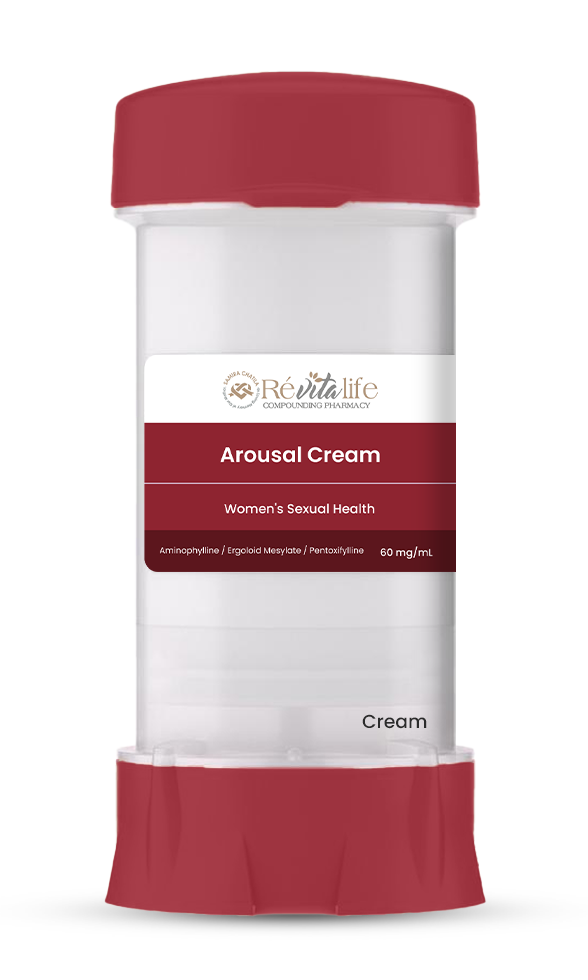
Arousal Cream
Available Dosage Strengths
About Arousal Cream
Arousal Cream is a pharmacist-compounded, non-sterile topical preparation that combines sildenafil citrate, testosterone, and L-arginine-into a single emollient base intended for localized dermal application to external genital skin.
By integrating multiple mechanisms that facilitate smooth-muscle relaxation, microvascular recruitment, and sensory neural modulation, the formulation is designed to assist clinicians in managing female sexual arousal disorder (FSAD) and other conditions characterized by insufficient genital blood flow or diminished arousal response. [1]
Its individualized nature allows prescribers to tailor active-ingredient profiles and concentrations to patient-specific therapeutic goals while avoiding excipients that may provoke irritation.
Because compounded preparations lack large-scale clinical trials, prescribers must rely on available ingredient-specific data, published case series, and pharmacologic rationale when selecting this therapy, and patients should receive counseling that outcomes vary and that systemic absorption, while typically low, can occur.
Dosage
The formulation’s therapeutic concept is synergistic vasodilation. Sildenafil citrate inhibits phosphodiesterase-5, preserving cyclic GMP and promoting nitric-oxide-mediated cavernous smooth-muscle relaxation; topical delivery allows high local concentrations with minimal systemic exposure. [3]
L-Arginine acts as a substrate for nitric-oxide synthase, potentially amplifying endothelial nitric-oxide production and supporting clitoral and vestibular engorgement. [4]
Testosterone may potentiate sexual motivation centrally and augment peripheral nitric-oxide pathways; transdermal absorption produces targeted androgenic signaling while avoiding hepatic first-pass metabolism. [5]
Mechanisms of Action
The formulation’s therapeutic concept is synergistic vasodilation. Sildenafil citrate inhibits phosphodiesterase-5, preserving cyclic GMP and promoting nitric-oxide-mediated cavernous smooth-muscle relaxation; topical delivery allows high local concentrations with minimal systemic exposure. [3]
L-Arginine acts as a substrate for nitric-oxide synthase, potentially amplifying endothelial nitric-oxide production and supporting clitoral and vestibular engorgement. [4]
Testosterone may potentiate sexual motivation centrally and augment peripheral nitric-oxide pathways; transdermal absorption produces targeted androgenic signaling while avoiding hepatic first-pass metabolism. [5]
Contraindications & Precautions
Use is contraindicated in individuals with known hypersensitivity to any component; in patients concurrently receiving nitrates or potent nitric-oxide donors because sildenafil-induced systemic vasodilation could precipitate severe hypotension; in those with active migraine or Raynaud phenomenon where ergoloid mesylate may exacerbate vasospasm; in severe hepatic impairment where testosterone metabolism is unpredictable; and in persons with uncontrolled bleeding disorders, peptic-ulcer disease, or history of intracerebral hemorrhage, given pentoxifylline’s antiplatelet effects and potential testosterone-related alterations in clotting factors. [10] [11]
Patients with arrhythmias, uncontrolled hypertension, or recent myocardial infarction should avoid aminophylline-containing products due to positive chronotropic effects, and those with hormone-sensitive malignancies (e.g., breast, endometrial) must not use testosterone-containing variants. Because safety data in pediatrics are absent, Arousal Cream is restricted to adult use.
Concomitant application on broken or inflamed skin is contraindicated owing to increased systemic uptake risk. [12]
Interactions
Significant pharmacokinetic and pharmacodynamic interactions stem from the diverse ingredient profile. Co-administration of organic nitrates or riociguat with sildenafil can trigger profound hypotension; alpha-blockers may synergistically lower systemic blood pressure. [13]
Concurrent use of strong CYP3A4 inhibitors (e.g., ketoconazole, ritonavir) may elevate sildenafil and testosterone levels, necessitating interval spacing or dose reduction.
Warfarin coupled with testosterone has been linked to increased international normalized ratio (INR) and bleeding episodes, warranting enhanced monitoring. [15]
Because topical absorption is variable, clinicians should still assess systemic medication lists as though oral dosages were used. [17]
Adverse Reactions / Side Effects
Localized adverse reactions-transient erythema, warmth, pruritus, or mild burning-occur in up to one-third of users and are generally self-limiting; occlusive dressings or application to recently shaved skin can intensify irritation. [18]
Systemic events are uncommon but possible: mild headache, nasal congestion, flushing, palpitations (sildenafil-related), tachycardia or insomnia (aminophylline), lightheadedness or dizziness (pentoxifylline), androgenic effects such as acne, fine hair growth, or mood changes (testosterone), and rare paresthesias (ergoloid mesylate).
Excessive application or impaired skin barrier can increase bioavailability, potentiating hypotension, priapism, or arrhythmogenic events, necessitating prompt medical evaluation.
Allergic contact dermatitis, though rare, has been documented with compounded bases and should prompt discontinuation and allergen testing.
Long-term safety beyond six months of continuous daily use has not been established; periodic reassessment is advised. [19]
Pregnancy & Breastfeeding
Each active ingredient carries distinct reproductive-risk profiles. Sildenafil’s limited human data suggest acceptable maternal tolerance, but fetal benefit remains unproven, and systemic vasodilation could compromise placental perfusion in susceptible patients. [20]
Testosterone-containing variants are strictly contraindicated in pregnancy (category X) because virilization of a female fetus can occur with even minimal systemic absorption. [22]
L-Arginine supplementation has been investigated for preeclampsia prevention and intrauterine growth restriction; although generally considered safe, topical pharmacokinetics during gestation are undefined. [23]
Because inadvertent dermal transfer to partners or neonates is possible, pregnant individuals or those attempting conception should avoid exposure to the cream, and caregivers should employ barrier methods or washable gloves during application. [24]
Storage
Store tightly closed at 20 °C to 25 °C (68 °F – 77 °F). Protect from excessive moisture, heat, and direct sunlight to maintain chemical stability and emulsion integrity.
References
01. Urology Times. (2024). Topical sildenafil cream found safe and tolerable in female sexual arousal disorder. [https://www.urologytimes.com/view/topical-sildenafil-cream-found-safe-tolerable-in-female-sexual-arousal-disorder\\
\- Link Opens in New Tab](https://www.urologytimes.com/view/topical-sildenafil-cream-found-safe-tolerable-in-female-sexual-arousal-disorder)
02. Department of Veterans Affairs. (2025, March). Transdermal testosterone (off-label) for hypoactive sexual desire disorder: Clinical summary. [https://www.va.gov/formularyadvisor/DOC\_PDF/CRE\_Testosterone\_HSDD\_Clinical\_Summary\_Mar\_2025.pdf\\
\- Link Opens in New Tab](https://www.va.gov/formularyadvisor/DOC_PDF/CRE_Testosterone_HSDD_Clinical_Summary_Mar_2025.pdf)
03. Berkeley Life Professional. (2024). Nitric oxide: A critical key to female sexual wellness. [https://berkeleylifeprofessional.com/wp-content/uploads/2023/08/WP\_Female-Sexual-Wellness-NO\_2.pdf\\
\- Link Opens in New Tab](https://berkeleylifeprofessional.com/wp-content/uploads/2023/08/WP_Female-Sexual-Wellness-NO_2.pdf)
07. GoodRx. (2024). Sildenafil interactions to be aware of. [https://www.goodrx.com/sildenafil/interactions\\
\- Link Opens in New Tab](https://www.goodrx.com/sildenafil/interactions)
08. Drugs..com. (2024). Aminophylline: Professional patient advice. [https://www.drugs.com/ppa/aminophylline.html\\
\- Link Opens in New Tab](https://www.drugs.com/ppa/aminophylline.html)
09. Ferreira, R., & colleagues. (2017). Sildenafil in pregnancy: A systematic review of maternal tolerance and obstetric outcomes. Fetal Diagnosis and Therapy, 41(2), 81-89. [https://doi.org/10.1159/000447745\\
\- Link Opens in New Tab](https://doi.org/10.1159/000447745)
10. United States Pharmacopeia. (2023). USP compounding standards and beyond-use dates fact sheet. [https://www.usp.org/sites/default/files/usp/document/our-work/compounding/usp-bud-factsheet.pdf\\
\- Link Opens in New Tab](https://www.usp.org/sites/default/files/usp/document/our-work/compounding/usp-bud-factsheet.pdf)
11. Trials Journal. (2023). Pentoxifylline for venous leg ulcers meta-analysis. [https://trialsjournal.biomedcentral.com/articles/10.1186/s13063-023-07547-y\\
\- Link Opens in New Tab](https://trialsjournal.biomedcentral.com/articles/10.1186/s13063-023-07547-y)
18. Ferri, N., & colleagues. (2023). L-Arginine supplementation in pregnancy: A systematic review. Journal of Maternal-Fetal & Neonatal Medicine. [https://doi.org/10.1080/14767058.2023.2217465\\
\- Link Opens in New Tab](https://doi.org/10.1080/14767058.2023.2217465)
19. Pourcelot, A., & colleagues. (2019). The effects of sildenafil on maternal and fetal outcomes in pregnancy: A systematic review. PLOS ONE, 14(7), e0219732. [https://doi.org/10.1371/journal.pone.0219732\\
\- Link Opens in New Tab](https://doi.org/10.1371/journal.pone.0219732)
20. FDA. (2024). TRENTAL (pentoxifylline) prescribing information. [https://www.accessdata.fda.gov/drugsatfda\_docs/label/2012/018631s039lbl.pdf\\
\- Link Opens in New Tab](https://www.accessdata.fda.gov/drugsatfda_docs/label/2012/018631s039lbl.pdf)
21. American Journal of Obstetrics and Gynecology. (2022). Prenatal exposure to teratogenic medications in the era of REMS. [https://doi.org/10.1016/j.ajog.2022.01.008\\
\- Link Opens in New Tab](https://doi.org/10.1016/j.ajog.2022.01.008)
22. Food and Drug Administration. (2023). Product-specific guidances for topical products. [https://www.fda.gov/media/173387/download\\
\- Link Opens in New Tab](https://www.fda.gov/media/173387/download)
23. Burnett, A. L. (2009). Endothelial nitric oxide synthase regulation in female genital tract and sexual arousal. Journal of Sexual Medicine, 6(Suppl 3), 247-253. [https://doi.org/10.1111/j.1743-6109.2008.01122.x\\
\- Link Opens in New Tab](https://doi.org/10.1111/j.1743-6109.2008.01122.x)
24. Alkilani, A., & colleagues. (2024). Advancements in transdermal drug delivery: A comprehensive review of penetration-enhancer strategies. International Journal of Pharmaceutics, 636, 122806. [https://doi.org/10.1016/j.ijpharm.2024.122806\\
\- Link Opens in New Tab](https://doi.org/10.1016/j.ijpharm.2024.122806)
25. Parish, S. J., Simon, J. A., Davis, S. R., Giraldi, A., Goldstein, I., & International Society for the Study of Women’s Sexual Health. (2021). International Society for the Study of Women’s Sexual Health clinical practice guideline for the use of systemic testosterone for hypoactive sexual desire disorder in women. Journal of Sexual Medicine, 18(5), 849-867. [https://doi.org/10.1016/j.jsxm.2020.10.009\\
\- Link Opens in New Tab](https://doi.org/10.1016/j.jsxm.2020.10.009)
26. Parish, S. J., & Kling, J. M. (2023). Testosterone use for hypoactive sexual desire disorder in postmenopausal women (NAMS Practice Pearl). North American Menopause Society. [https://www.huntingtonhealth.org/wp-content/uploads/2024/09/NAMS\_practice-pearl-testosterone\_.pdf\\
\- Link Opens in New Tab](https://www.huntingtonhealth.org/wp-content/uploads/2024/09/NAMS_practice-pearl-testosterone_.pdf)
Related Medications
About Us
We believe in a comprehensive approach to healthcare that blends traditional wisdom with cutting-edge techniques to deliver personalized care that addresses not just the symptoms, but also the underlying causes of your health concerns.
Frequently asked questions
Our team of experts has the answers you’re looking for.
How quickly does Arousal Cream work after application?
Most patients report perceivable warmth or engorgement within 10-20 minutes as local vasodilation develops. [11]
Can it be used with systemic PDE-5 inhibitors like oral sildenafil?
Combination is generally discouraged because additive hypotension and priapism risk outweigh potential benefit. [12]
Is the product scented or flavored?
The default base is unscented.
How quickly does Arousal Cream work after application?
Most patients report perceivable warmth or engorgement within 10-20 minutes as local vasodilation develops. [11]
Will testosterone in the cream cause virilizing side effects?
At prescribed dermal doses systemic absorption is low, but transient acne or fine facial hair can appear in some users; routine monitoring mitigates concerns. [14]
Can partners absorb the medication transdermally?
Yes; partners should avoid direct contact with treated skin until the area is washed, or the product fully dries to prevent systemic exposure. [15]
What if a dose is accidentally applied to broken skin?
Wash immediately; compromised barrier can accelerate systemic uptake and elevate adverse-event risk. [16]
Does alcohol intake affect efficacy or safety?
Moderate alcohol use may potentiate hypotension from sildenafil; excessive intake increases vasodilatory dizziness and should be avoided. [17]
Can menopausal hormone therapy be continued concurrently?
Yes, but clinicians should review estrogen doses because combined vasodilatory effects may alter blood pressure and vascular reactivity. [19]
Is there a risk of developing tolerance over time?
No pharmacologic tolerance is documented; nevertheless, psychological adaptation may blunt perceived benefit, warranting periodic drug holidays. [20]
How should leftover product be disposed of?
Return unused cream to the pharmacy for chemical disposal; do not flush or discard in household trash to avoid environmental contamination. [21]
Does insurance cover compounded Arousal Cream?
Most insurers classify it as non-formulary; patients typically self-pay, but health-savings accounts may reimburse with a prescription. [23]