Available through:
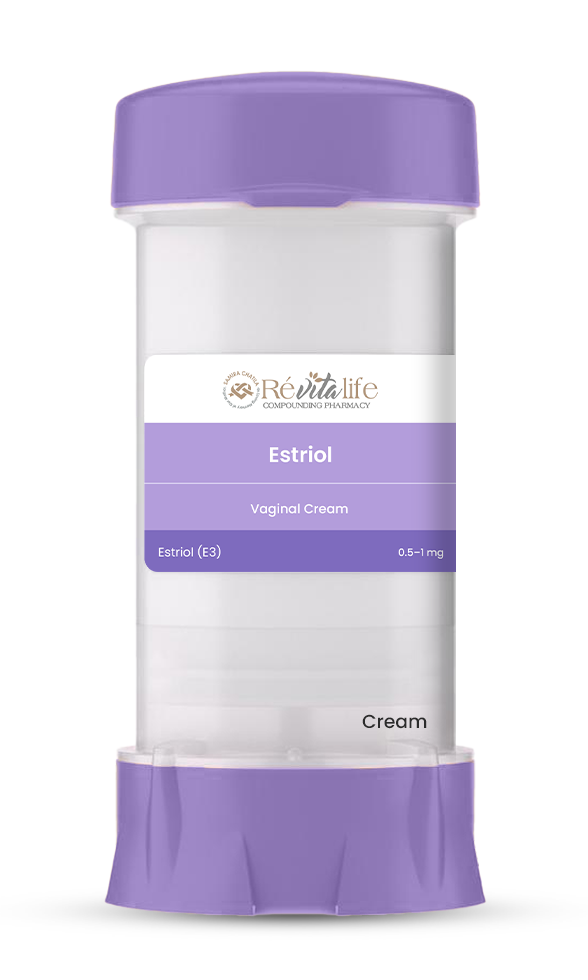
Estriol Vaginal Cream
Available Dosage Strengths
Mechanism of Action
Estriol (E3) is a weak estrogen, but highly effective locally inside the vagina.
Local mechanisms (primary)
- Binds to estrogen receptors (ER-α and ER-β) in vaginal epithelium.
- Increases cell proliferation → thicker, more elastic epithelium.
- Restores vaginal pH (acidic) by increasing glycogen → supports Lactobacillus.
- Improves lubrication, reduces dryness and micro-tears.
- Increases local blood flow.
- Strengthens urethral mucosa, helping reduce recurrent UTIs.
Systemic
- Very minimal systemic absorption compared to estradiol.
- Very low endometrial stimulation at low maintenance doses.
Dosage (Clinical Regimens)
Standard dosing
Initial (loading):
- 5 mg – 1 mg estriol vaginal cream, once daily for 2–3 weeks.
Maintenance:
- 2–3 times per week (most common = twice weekly, e.g., Mon–Thu).
Application
- Apply at bedtime for better retention.
- Insert into lower third of vagina.
- Optionally a small amount may be applied externally for vulvar dryness.
Adjustment
- Severe atrophy → daily for 3–4 weeks then taper.
- Maintenance long-term is safe due to minimal systemic effect.
Indications
- Genitourinary syndrome of menopause (GSM)
- Vaginal dryness
- Dyspareunia (pain with intercourse)
- Vulvovaginal atrophy
- Postmenopausal itching/burning
- Recurrent UTIs due to atrophy
- Post-partum low estrogen (off-label in some regions)
Contraindications
Avoid or use only with specialist supervision in:
- History of estrogen-dependent malignancy (e.g., breast cancer)
- Undiagnosed vaginal or uterine bleeding
- Active or history of DVT/PE
- Severe liver dysfunction
- Known or suspected pregnancy
- Hypersensitivity to estriol or excipients
Note: Some breast cancer patients may still use low-dose vaginal estrogen under oncologist approval.
Side Effects
Local (most common)
- Mild irritation/burning
- Itching
- Increased vaginal discharge
- Light spotting
- Vulvar sensitivity
Systemic (rare due to low absorption)
- Breast tenderness
- Headache
- Mild nausea
- Fluid retention
- Mood changes (rare)
Drug Interactions
Estriol vaginal cream has very low interaction risk, but possible considerations:
May need caution
- Aromatase inhibitors (AI)
- Small systemic rise in estrogen possible → check with oncologist.
- Warfarin
- Theoretical changes in clotting if high doses used; monitor INR.
- Vaginal antifungals, lubricants, oils
- May reduce absorption → apply estriol at a different time (prefer bedtime).
Generally safe with
- Most systemic medications
- Antibiotics
- Antihypertensives
- Thyroid medication
- SSRIs/SNRIs
- Supplements
References (Clinical & Scientific)
Key references used in clinical practice:
- North American Menopause Society (NAMS) 2020 & 2023 Position Statements – Hormone therapy & vaginal estrogen guidelines.
- EMAS (European Menopause and Andropause Society) Clinical Guidelines – Local estrogen therapy for GSM.
- “Vaginal estrogen for genitourinary syndrome of menopause: a systematic review.” Menopause, 2020.
- Eriksen PS et al. “A comparative study of estriol and estradiol vaginal cream.” Acta Obstet Gynecol Scand.
- Santen RJ. “Systemic absorption of vaginally administered estrogen.” J Clin Endocrinol Metab.
- Palma F. “Estriol vaginal cream efficacy and safety.”
- ISSWSH Clinical Practice Guidelines for GSM (2020).
- ACOG Practice Bulletin – Treatment of urogenital symptoms with vaginal estrogen.
Estriol vaginal cream is a form of hormone replacement therapy used to treat vaginal dryness, burning, and itching, and other symptoms associated with menopause, such as pain during intercourse. It is a topical estrogen that works by restoring vaginal tissue