Available through:
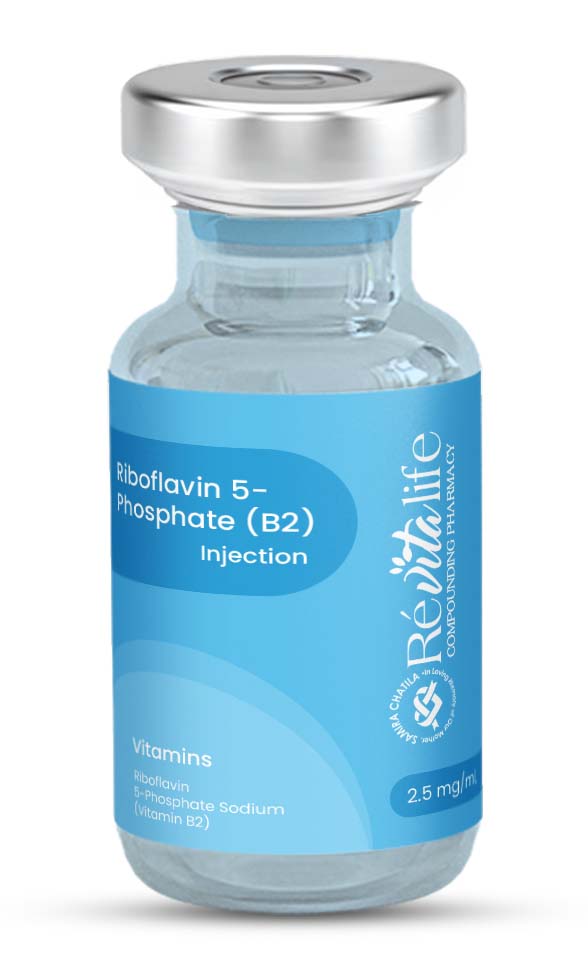
Riboflavin 5 Phosphate Sodium (VIT B2) Injection
Available Dosage Strengths
About Riboflavin 5 Phosphate Sodium (VIT B2) Injection
Generic name: Riboflavin-5-Phosphate Sodium
Synonyms: Flavin mononucleotide (FMN), Riboflavin sodium phosphate
Drug class: Water-soluble vitamin; precursor to flavoprotein coenzymes
Formulation: Sterile injectable solution for IV use
Typical concentration: 1–10 mg/mL depending on manufacturer
Appearance: Clear yellow to orange solution; strongly fluorescent
Clinical uses include:
- Nutritional supplementation in deficiency states (malabsorption, alcoholism, prolonged TPN)
- Supportive therapy in mitochondrial disorders
- Adjunctive therapy in migraines (IV preparation sometimes used in infusion therapy programs)
- Part of multivitamin IV infusion formulas (“IV drips”)
- Situations requiring rapid replacement of riboflavin stores
Pharmacology summary:
Riboflavin-5-phosphate is the phosphorylated, active form of riboflavin and a direct precursor to FMN and FAD, essential coenzymes in oxidative metabolism, energy production, and antioxidant pathways.
Dosage
(Doses may vary based on institutional protocols; adjust according to patient condition.)
General supplementation:
- 5–50 mg IV as part of an IV multivitamin or infusion mixture.
- Administer diluted in compatible IV fluids (e.g., NS or D5W).
- Infuse over 30–60 minutes to minimize irritation.
Riboflavin deficiency:
- 10–25 mg IV daily until clinical improvement, then switch to oral therapy.
Mitochondrial / metabolic support (off-label):
- 25–100 mg IV, frequency varies per specialist recommendation.
Migraine therapy (off-label):
- 50–100 mg IV as part of an infusion protocol (often combined with magnesium and other vitamins).
Note: Riboflavin is generally very safe, but IV administration should be performed under clinical supervision.
Mechanisms of Action
Riboflavin-5-phosphate (FMN) is a biologically active form of vitamin B2 and precursor to flavin adenine dinucleotide (FAD).
Both FMN and FAD act as essential coenzymes in:
A. Cellular Energy Production
- FMN and FAD participate in oxidation-reduction (redox) reactions in:
- Electron transport chain (Complex I & II)
- Krebs cycle
- β-oxidation of fatty acids
- Supports ATP generation and mitochondrial function.
B. Antioxidant Activity
- Coenzyme for glutathione reductase, essential for maintaining reduced glutathione (GSH).
- Supports detoxification and oxidative stress management.
C. Amino Acid & Drug Metabolism
- Cofactor in metabolism of:
- Tryptophan
- Pyridoxine (Vitamin B6 activation)
- Niacin synthesis
- Various xenobiotics (cytochrome P450 function)
D. Maintenance of Healthy Skin, Eyes, and Mucous Membranes
- Supports epithelial cell turnover
- Promotes normal vision and prevents corneal vascularization
E. Hematologic Function
- Important for normal erythropoiesis
Deficiency can contribute to anemia
Contraindications & Precautions
Absolute Contraindications:
- Known hypersensitivity to riboflavin or any component of the formulation.
Relative Precautions:
- Renal impairment: Riboflavin is renally excreted; accumulation is not dangerous but may cause more intense yellow urine.
- History of photosensitivity disorders: Riboflavin can increase photosensitivity; advise avoidance of excessive UV exposure.
- Gallbladder disease: High doses rarely increase bilirubin mildly; caution in severe liver dysfunction.
- IV site irritation: Highly colored solution may cause local irritation or staining of tissues in case of extravasation.
Special Monitoring:
- Infusion site for irritation
- Allergic reactions (rare)
- Avoid exposure of solution to strong light (vitamin is light-sensitive)
Interactions
Drug Interactions:
- Anticholinergic drugs: May delay gastric emptying, but relevant only to oral administration.
- Probenecid: Can reduce riboflavin renal clearance.
- Photosensitizing drugs (e.g., tetracyclines, thiazides): Riboflavin may enhance photosensitivity.
- Chlorpromazine, TCAs, some anticonvulsants: Chronic use may reduce riboflavin levels.
Lab Interactions:
- High-dose riboflavin can cause false elevation or interference in:
- Urine colorimetric tests
- Some fluorometric assays (due to natural fluorescence)
Food interactions: Not applicable to IV administration.
Adverse Reactions / Side Effects
Riboflavin is generally very safe; adverse effects are usually mild.
Common:
- Bright yellow urine (harmless)
- Mild warmth or flushing during infusion
- Mild local irritation at IV site
Less Common:
- Headache
- Dizziness
- Nausea (usually if given too rapidly)
- Hypersensitivity reactions (rare)
Rare but serious:
- Anaphylactoid reaction (extremely rare)
- Extravasation can cause local tissue staining and irritation
Pregnancy & Breastfeeding
Pregnancy:
- Riboflavin is Category A equivalent (safe in pregnancy).
- Required for fetal development; deficiency can cause maternal anemia and fetal growth impairment.
- IV supplementation acceptable if clinically indicated.
Breastfeeding:
- Riboflavin is excreted in breast milk, but safe and considered beneficial.
- No known adverse effects in infants at therapeutic doses.
Storage
- Store at 20–25°C (68–77°F) unless otherwise specified by manufacturer.
- Protect from light—riboflavin is highly photosensitive.
- Do not freeze.
- Use within recommended time after opening vial; discard unused portion according to sterile handling guidelines.
References
(Standard medical/pharmaceutical references – no external links)
- Micromedex Drug Reference – Riboflavin and Riboflavin-5-Phosphate
- Lexicomp Online – Riboflavin Monograph
- British National Formulary (BNF) – Vitamin B2
- NIH Office of Dietary Supplements – Riboflavin Fact Sheet
- Remington: The Science and Practice of Pharmacy
- Goodman & Gilman’s: The Pharmacological Basis of Therapeutics