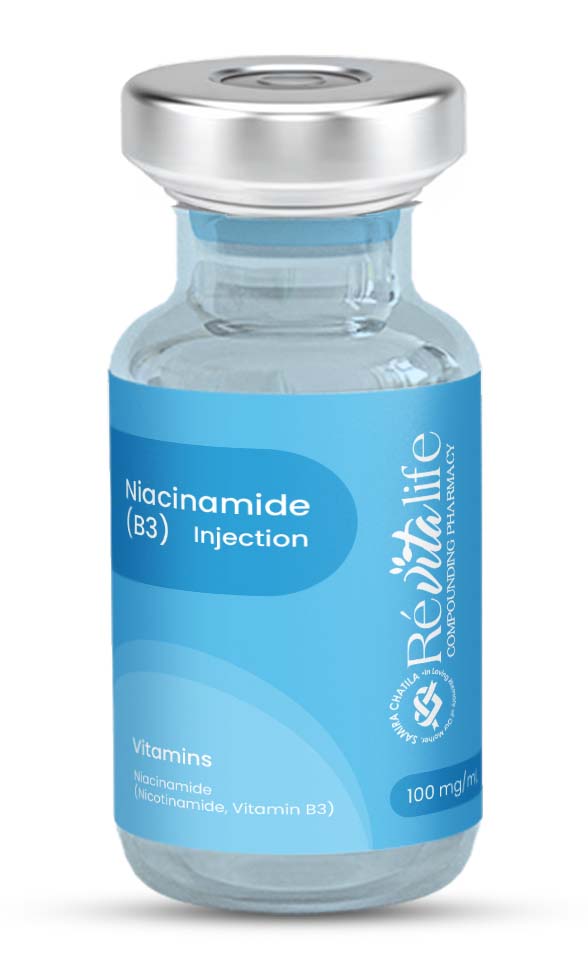
Available through:
Niacinamide Injection
Available Dosage Strengths
About Niacinamide Injection
Generic Name: Niacinamide (Nicotinamide)
Class: Water-soluble vitamin; Vitamin B3 amide derivative
Pharmacologic Category: Nutritional supplement; coenzyme precursor
Available Forms (clinical use):
- Injectable niacinamide (varies by manufacturer; usually 100 mg/mL or similar concentration)
- Also available in oral tablet/capsules, but this monograph addresses IV use
Clinical Indications for Injectable Niacinamide (evidence-based):
- Treatment or prevention of niacin deficiency (pellagra) when oral administration is not possible
- Part of specially formulated parenteral nutrition solutions
- Severe malabsorption states requiring parenteral vitamin support
Off-label uses sometimes seen in wellness clinics:
- Part of “IV vitamin drips,” antioxidant infusions, “skin brightening” protocols
Important: These uses lack robust clinical trial data and should be performed only with full informed consent and medical oversight.
Dosage
Important Safety Note: Specific IV dosing should only be determined by a licensed prescriber. Below are standard medical references, not individualized medical advice.
Evidence-Based Therapeutic Doses (for deficiency / hospital use)
- Adults: Typically 100–500 mg/day IV, depending on severity of deficiency and clinical status
- Pellagra (severe deficiency): Sometimes up to 1,000 mg/day divided IV/IM/PO, then tapered
- Parenteral nutrition: Incorporated into multivitamin formulations (usually 40 mg/day)
Infusion Considerations
- Given slow IV infusion to reduce adverse reactions
- Should not be mixed with incompatible solutions (see interactions)
- Must use sterile, preservative-free medical-grade products intended for injection
NOT recommended:
- Very high-dose IV niacinamide for “anti-aging,” “detox,” or “energy drips,” due to lack of evidence and risk of hepatic toxicity.
Mechanisms of Action
Niacinamide is a biologically active form of Vitamin B3 that acts as a precursor of:
1. NAD⁺ (Nicotinamide adenine dinucleotide)
- Essential for cellular energy metabolism (glycolysis, Krebs cycle, oxidative phosphorylation)
- Required for ATP production in mitochondria
2. NADP⁺ (Nicotinamide adenine dinucleotide phosphate)
- Important for fatty acid synthesis, cholesterol metabolism, and detoxification reactions
- Plays a major role in antioxidant pathways (glutathione regeneration)
3. DNA Repair & Cell Survival
Niacinamide supports enzymes such as:
- Poly(ADP-ribose) polymerases (PARPs) — involved in DNA repair
- Sirtuins — regulate aging, metabolism, and inflammation
4. Anti-inflammatory Actions
- Reduces production of inflammatory cytokines
- Modulates neutrophil chemotaxis
- Stabilizes epidermal barrier function
5. Skin Effects
- Reduces melanosome transfer (may help hyperpigmentation)
- Improves epidermal barrier by increasing ceramide synthesis
- Antioxidant properties reduce oxidative stress
Contraindications & Precautions
Absolute Contraindications
- Known hypersensitivity to niacinamide or formulation components
- Severe hepatic impairment (risk of hepatotoxicity)
Relative Contraindications / Use With Caution
- Renal impairment (accumulation possible at very high doses)
- Active peptic ulcer disease
- Uncontrolled gout or hyperuricemia
- Diabetes mellitus
- Niacinamide may affect glucose tolerance
- Hypotension
- Vasodilatory effects may exacerbate low blood pressure
- History of severe flushing reaction to niacin
- Niacinamide produces minimal flushing but caution is still advised
IV-specific Precautions
- Must be given slowly to prevent local irritation or systemic reactions
- Monitor LFTs in prolonged or high-dose therapy
- Use caution in patients with multiple vitamin infusions to avoid cumulative toxicity
Drug & Nutrient Interactions
Potential Interactions
- Carbamazepine, valproic acid
- Additive hepatic stress
- Isoniazid
- Alters vitamin metabolism; may require adjustment
- Anticoagulants (warfarin)
- Rare reports of altered INR; monitor closely
- Hypoglycemic agents
- Niacinamide may impair glucose tolerance
Nutrient Interactions
- Works synergistically with riboflavin (B2), which helps NAD/NADP recycling
- High doses may alter metabolism of other B-complex vitamins
- In parenteral nutrition, must be included in balanced multivitamin mixture to prevent imbalance
Compatibility (IV)
- Compatible in many parenteral nutrition solutions
- Avoid mixing with:
- Strong oxidizing agents
- Highly alkaline solutions
- Calcium-rich mixtures unless verified safe
Adverse Reactions / Side Effects
Common (usually dose-dependent)
- Nausea, vomiting
- Headache
- Mild flushing or warmth
- Injection-site irritation
- Dizziness or lightheadedness
- Mild hypotension
Moderate
- Hepatotoxicity (elevated ALT/AST)
- Hyperuricemia / gout flare
- Insulin resistance or hyperglycemia
- GI upset
Severe / Rare
- Acute liver failure (extremely high doses)
- Thrombocytopenia
- Anaphylactoid reactions (very rare)
- Severe hypotension during rapid IV infusion
Monitoring Requirements for IV Use
- Liver function tests (especially with repeated or high-dose use)
- Renal function
- Blood glucose in diabetic patients
Blood pressure during infusion
Pregnancy & Breastfeeding
Pregnancy
- Niacinamide is generally considered safe in pregnancy when used in standard nutritional doses.
- High-dose IV therapy has not been extensively studied, and should only be administered if medically necessary.
- Animal studies do not show teratogenicity at standard doses.
Breastfeeding
- Niacinamide is excreted into breast milk in small amounts.
- Standard doses are considered compatible with breastfeeding.
- High or therapeutic IV doses should be used with caution and require risk-benefit evaluation.
Storage
- Store vials at controlled room temperature: 20–25°C (68–77°F)
- Protect from light to prevent degradation
- Do not freeze
- Use only clear solutions—discard if cloudy, tinted, or particulate matter present
- Use single-dose vials promptly after opening (if not preservative-free)
- Follow manufacturer-specific storage recommendations
References
(Professional medical & pharmacologic sources)
- NIH Office of Dietary Supplements. Niacin Fact Sheet – National Institutes of Health
- Lexicomp Online / UpToDate – Niacinamide drug monograph
- Micromedex (IBM Watson) – Niacinamide injectable formulation data
- American Society for Parenteral and Enteral Nutrition (ASPEN) – Parenteral vitamin guidelines
- Carpenter KJ. Niacin. Academic Press.
- World Health Organization (WHO). Parenteral Nutrition Guidelines.
- Chan AY. Adverse effects of high-dose niacin therapy. Clin Pharmacol Ther.