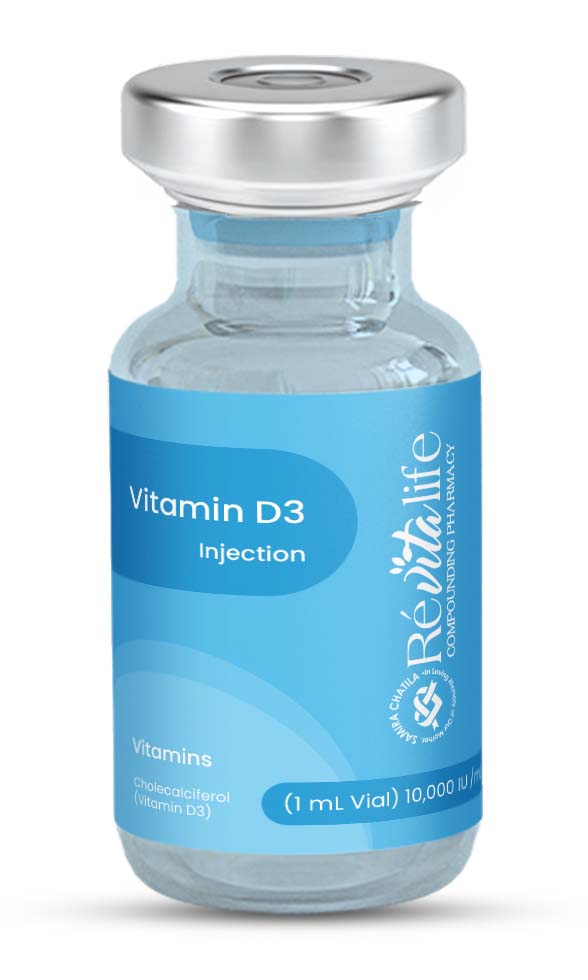
Vitamin D3 Injection from RevitaLife Compounding Pharmacy

Available through:

Vitamin D3 Injection

Available Dosage Strengths
Cholecalciferol (Vitamin D3)
(1 mL Vial) 10,000 IU /mL(2 mL Vial) 20,000 IU /mL(3 mL Vial) 30,000 IU /mL(10 mL Vial) 100000 IU /mL

Vitamin D3 (cholecalciferol) is a fat-soluble vitamin essential for calcium and phosphate homeostasis, bone mineralization, immune regulation, and neuromuscular function. When administered intravenously or intramuscularly, it bypasses gastrointestinal absorption and ensures predictable bioavailability—an option for patients with malabsorption syndromes, severe deficiency requiring rapid repletion, or contraindications to oral therapy.

Common Parenteral Forms:

  • Cholecalciferol injection (variable concentrations depending on manufacturer).
  • Some regions use Calcifediol (25-hydroxy-vitamin D) or Calcitriol (1,25-dihydroxy-vitamin D) instead of cholecalciferol for parenteral use; however, the request was for D3 (cholecalciferol).
Exact doses must be determined by a healthcare professional based on serum 25-OH vitamin D levels, calcium status, comorbidities, and indication.

A. Therapeutic Repletion (Severe Deficiency)

  • Typical IV/IM ranges:
    10,000 – 300,000 IU administered as a single dose or divided doses over weeks (depending on regional protocols and formulation).
  • Monitoring of serum calcium, phosphate, and 25-OH vitamin D is required.

B. Maintenance Therapy

  • Usually oral; parenteral maintenance may be:
    10,000 – 30,000 IU every 1–3 months (IM more common than IV).

Caution

  • Overshooting levels can cause hypervitaminosis D and hypercalcemia.
  • Use lower doses in chronic kidney disease unless active forms (calcitriol) are used.

Vitamin D3 undergoes two hydroxylation steps:

  1. Liver: Cholecalciferol → 25-hydroxyvitamin D (Calcifediol)
  2. Kidney: 25-OH vitamin D → 1,25-dihydroxyvitamin D (Calcitriol) (biologically active)

Physiological effects:

A. Calcium and Phosphate Regulation

  • ↑ Intestinal absorption of calcium and phosphate
  • ↑ Renal reabsorption of calcium
  • Mobilizes calcium from bone when serum levels are low

B. Bone Health

  • Promotes mineralization of osteoid
  • Prevents osteomalacia and rickets

C. Endocrine Effects

  • Suppresses parathyroid hormone (PTH) in cases of secondary hyperparathyroidism

D. Immunomodulatory Actions

  • Enhances innate immunity (cathelicidin, macrophage function)
  • Modulates adaptive immunity (reduces pro-inflammatory cytokines)

E. Cellular & Genomic Effects

  • Vitamin D receptor (VDR) activation influences gene transcription, cell differentiation, and regulation of proliferation.

A. Absolute Contraindications

  • Hypercalcemia
  • Vitamin D toxicity
  • Severe hyperparathyroidism unless treated/controlled
  • Hypersensitivity to cholecalciferol or formulation excipients

B. Relative Contraindications / Use with Caution

  • Chronic Kidney Disease (CKD) → impaired conversion; risk of hypercalcemia; may require active analogs instead
  • Sarcoidosis or granulomatous diseases → risk of endogenous overproduction of calcitriol → hypercalcemia
  • Lymphoma (certain types increase 1-α-hydroxylase activity)
  • Nephrolithiasis (Kidney stones) – especially calcium stones
  • Cardiac disease – because hypercalcemia can precipitate arrhythmias
  • Hepatic impairment – affects first hydroxylation step

A. Drug–Drug Interactions

  • Thiazide diuretics → increased hypercalcemia risk
  • Digoxin → hypercalcemia increases risk of digoxin toxicity/arrhythmias
  • Corticosteroids → reduce vitamin D metabolism and effectiveness
  • Anticonvulsants (phenytoin, phenobarbital, carbamazepine) → increase vitamin D catabolism
  • Orlistat → may reduce absorption of fat-soluble vitamins (relevant only to oral dosing)
  • Cholestyramine/colestipol → similar to above
  • Ketoconazole → inhibits vitamin D metabolism

B. Lab Interference

  • High vitamin D levels can alter calcium, phosphate, PTH, and alkaline phosphatase test interpretation.

Common (generally dose-related, often due to hypercalcemia):

  • Nausea, vomiting
  • Polyuria, polydipsia
  • Fatigue, weakness
  • Headache
  • Constipation

Moderate to Severe:

  • Hypercalcemia (most clinically important)
  • Nephrolithiasis
  • Renal impairment (from hypercalcemia)
  • Calcification of soft tissues
  • Cardiac arrhythmias (particularly in patients on digoxin)
  • Mental status changes (confusion, lethargy)

Injection-related (IV/IM):

  • Local pain or irritation
  • Rare: hypersensitivity reactions

Pregnancy

  • Vitamin D is essential for maternal and fetal bone health.
  • Parenteral therapy may be used in cases of severe deficiency or malabsorption under specialist supervision.
  • Excess vitamin D during pregnancy can cause fetal hypercalcemia and growth abnormalities.

Breastfeeding

  • Vitamin D passes into breast milk in small amounts.
  • Parenteral supplementation is generally considered safe if monitored.

Safety Category

  • Historically considered pregnancy Category C (risk cannot be ruled out), but current thinking emphasizes that deficiency is more harmful than supplementation when used appropriately.
  • Store at 20–25°C (68–77°F) unless manufacturer specifies otherwise.
  • Protect from light, as vitamin D is photosensitive.
  • Do not freeze.
  • Inspect parenteral solutions for particulate matter or discoloration before administration.
  • Keep vials tightly closed.

(Standard drug monograph–style references; no direct URLs included as per instructions)

  1. Holick MF. Vitamin D deficiency. N Engl J Med. 2007;357(3):266–281.
  2. Institute of Medicine (IOM). Dietary Reference Intakes for Calcium and Vitamin D. National Academies Press.
  3. “Vitamin D deficiency in adults: Definition, clinical manifestations, and treatment.”
  4. Rosen CJ. Clinical practice: Vitamin D insufficiency. N Engl J Med.
  5. European Medicines Agency (EMA) – Product Monographs for Cholecalciferol Injection.
  6. British National Formulary (BNF) – Vitamin D preparations.
  7. Endocrine Society Clinical Practice Guidelines (2011 & updates) on evaluation and treatment of vitamin D deficiency.
  8. World Health Organization (WHO) – Vitamin D supplementation safety.

Related Medications

Get in Touch

Contact Us To Get Better Information

Scroll to Top